


Tell us a little about yourself. What do you do at CERN?
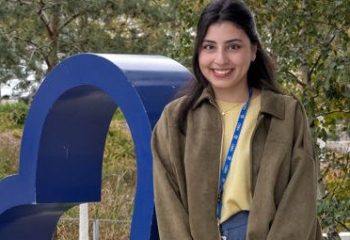
My name is Siba Alalwan. I am a Mechanical Engineer from Saudi Arabia, and I am part of the SND@LHC experiment at CERN.
My work focuses on developing mechanical systems for the dismantling and recovery of CMS Tracker silicon modules, components planned for reuse in the SND detector upgrade. This includes designing chariot structures and handling solutions adapted to the geometry of the CMS Tracker, supporting the safe extraction and manipulation of delicate silicon modules, working in CATIA for 3D modelling and design iterations, and participating in prototype assembly, design reviews, and mechanical validation activities.
What is working at CERN like?
It is my first working experience, and what a place to start.
I am surrounded by some of the most brilliant and generous people I have ever met. I was lucky to join a welcoming team and, most importantly, to have a supportive mentor. That makes an enormous difference when everything is new.
What strikes me most is that everyone here, whatever their role, is working towards one common mission. You do small, precise tasks, but they all feed into something much larger. That sense of shared purpose is something I had not felt before, and it has stayed with me.
I also carry something personal. I am the first Saudi to join the SND@LHC team. I do not hold that as a title. I hold it as a reminder that representation matters.
What inspired you to pursue STEM?
Honestly, I hated being told I could not do something.
I wanted an unusual path. I imagined myself working with engines and machines, doing something that was not the expected road for a young woman from Saudi Arabia. Mechanical engineering gave me a language for turning imagination into something real. A thought becomes a sketch, a sketch becomes a model, and a model becomes an object you can hold.
I did not grow up seeing many examples of Saudi women in hands-on engineering roles connected to major international experiments. So I had to imagine that path before I could walk it. That is something I am genuinely proud of, not because I want to be a symbol, but because I proved something to myself. And if my path makes it easier for someone else to imagine theirs, that matters too.
What skills have you developed since joining CERN?
Technically, I have built skills in mechanical design for complex detector environments, CAD, structural thinking, integration constraints, precision handling tools, and reading engineering drawings at a level I did not have before. I also learned CATIA from scratch, which I now use daily.
But the less obvious skills have been just as important. Good engineering here is never only technical. It requires knowing how to communicate across teams, how to document your work clearly, and how to ask the right questions, because a design has to make sense not just to you, but to everyone who will review, manufacture, and use it.
CERN also gives you room to grow. I have taken several courses, received strong mentorship, and been trusted with real responsibilities early on. Personally, I have become much more confident. You learn quickly that you do not need to walk in knowing everything. You need curiosity, humility, and the discipline to keep learning.
What have been the main challenges?
Entering an environment where almost everything is new; the systems, the terminology, the procedures, and the collaboration structure is genuinely overwhelming at first. Sitting in rooms with people who have spent decades on these systems can be intimidating.
The challenge for me was not adapting to a new country. That part I embraced. The harder thing was the technical depth: picking up legacy documentation, understanding complex assemblies, and contributing meaningfully while still learning the foundations.
What helped was showing up, asking questions without embarrassment, and trusting that each task was building something. Belonging is not always something you feel on day one. Sometimes it is something you build.
What is your most “CERN moment”?
Recently, I stayed night and day helping assemble our detector prototype during a test beam campaign. It was exhausting and completely absorbing. When I looked at the prototype afterwards, I could point to parts of it and say: I helped build that.
That was the moment it became real for me. A chariot, a handling tool, or a support frame, these are not just engineering objects at CERN. They are part of a chain that makes actual science possible. Being part of that chain, even at the level of a small mechanical detail, is something I will not forget.
What advice would you give applicants?
If CERN is where you want to be, aim for it and do not stop aiming. It may not be easy to get in, but do not give up.
Once you are here, you quickly realise it is a place built for learning. You are not expected to know everything from day one. What matters is that you are curious, serious, and ready to grow. Do not underestimate your background or your perspective. They may be exactly what makes your contribution valuable. And to young people from Saudi Arabia and the region, especially young women: there is a place for you in Science and Technology. Sometimes you may be the first. That is not a reason to hesitate. It is a reason to go.