


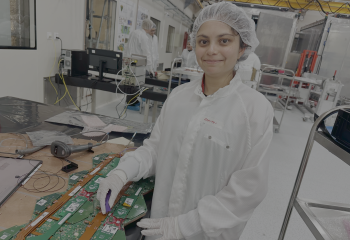
Tell us a little about yourself… What do you do at CERN today?
I’m a postdoctoral researcher at CERN working on the CMS experiment affiliated with the
University of Kansas. My focus is on particle physics, particularly analyses related to the Higgs
and Supersymmetry sectors and beyond the Standard Model. My day-to-day work is a mix of
physics analysis and hardware. I spend a lot of time coding and working with collision data, but
I’m also involved in testing silicon detector components that eventually become part of CMS. It’s
rewarding to see both sides, how the data is produced and how we use it to do physics.
What is working at CERN like for you?
Working at CERN is both exciting and humbling. You’re surrounded by people from all over the
world who are deeply passionate about science. It’s highly collaborative and no one works in
isolation, and sharing ideas is part of the culture. At the same time, the problems we tackle are
incredibly complex, which can be challenging, but that’s also what makes it so rewarding.
What inspired you to pursue a career in STEM? OR What is your first memory of
science?
My interest in science started with simple curiosity wanting to understand how things work and
why. Over time, that curiosity naturally evolved into physics. The idea that we can describe the
universe with mathematical models and then test them experimentally was what really drew me
in.
What skills have you developed since joining CERN?
Since joining CERN, I’ve developed both technical and personal skills. On the technical side,
I’ve strengthened my programming and data analysis abilities, especially with large datasets,
and learned how to approach complex problems more systematically. I’ve also gained hands-on
experience with silicon detector hardware testing, validating, and understanding how
components perform in the challenging environment of the LHC. There’s a special moment
when something you’ve worked on at the hardware level is integrated into the detector and
starts taking data—it almost “comes to life.”
On the personal side, working in large, diverse teams has helped me communicate ideas clearly
and adapt to different perspectives. Being at CERN also exposes you to cutting-edge
technologies and experimental setups, which is incredibly valuable for the future.
What have been the main challenges you encountered along the way?
The learning curve can be steep. You’re constantly exposed to new concepts, tools, and
technologies, whether it’s hardware systems or complex analysis frameworks. Research is also
unpredictable since things don’t always work the first time, whether it’s code or hardware tests.
Learning patience and persistence has been a key part of the process.
What’s the most “CERN moment” you’ve experienced?
One of the most memorable moments was seeing the scale of the CMS detector in person for
the first time. It really hits you that you’re part of something much bigger than yourself. There are
also moments when a piece of analysis finally works after weeks of debugging, that’s a very
“CERN moment” too! Then there are the smaller moments, like chatting over coffee and
realizing the person you’re talking to works on a completely different experiment, yet somehow it
all connects.
What advice would you give potential applicants?
I’d say—just apply, even if you’re not sure you’re the “perfect” fit. Many people here didn’t
expect to end up at CERN. It helps to have done something practical beforehand, like coding,
working with data, or hardware, but you don’t need to have everything figured out. Once you’re
here, there’s a lot happening beyond your own project, so getting involved more broadly is worth
it since that’s where some of the best experiences happen.