


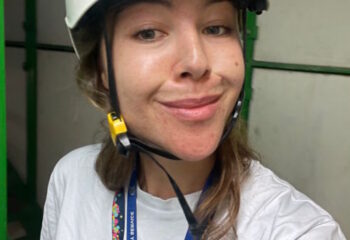
Tell us a little about yourself… What do you do at CERN today?
After studying mathematics at university, I decided to take a leap of faith and apply for the CERN Doctoral Student Programme. To my own surprise (I had no background in physics let alone accelerator physics) I was accepted am now working in the Advanced WAKefield Experiment (AWAKE).
AWAKE works on developing proton driven plasma wakefield acceleration. In order to accelerate a charged particle, an electric field is required. Plasmas are able to sustain much higher electric fields than conventional technologies, yielding the possibility to reach energies interesting for particle physics over much shorter accelerating distances.
In AWAKE the process involves a highly energetic proton beam (driver) from the CERN SPS entering a plasma. As the proton beam propagates in plasma it creates so called wakefields. A correctly placed (witness) particle bunch (an electron bunch in the case of AWAKE) within these wakefields can then be accelerated.
My PhD focuses on the correct placement in time and space of this electron bunch. This involves studying the best way to control the shape and transport of the electron bunch from its origin (a photocathode) to the location of injection (the wakefields). In addition, the electron bunch can also be used for other experiments in AWAKE. All of these requiring a high standard of understanding and control.
This involves not only simulating and understanding the plasma physics behind AWAKE but also the conventional accelerator physics of a transport line. My work includes everything from operating the machine, to installing instruments in the tunnel, writing data software tools, analysing data as well as presenting results up to attending conferences and writing physics papers.
What is working at CERN like for you?
Working at CERN for me combines the tangible with the intangible. I will never forget the first time I saw a particle bunch on a beam screen. Suddenly a whole new world opened itself to me.
Being able to not just visit but interact with and actively improve/shape and study technologies built and developed over decades of work and dedication is not only fascinating but also inspiring. This work and dedication reflects itself in the many experts of different fields, all working together on a common goal. I am extremely grateful for the many people along the way that have taught me and keep teaching me every day.
What inspired you to pursue a career in STEM?
The intellectual challenge along with the drive to try and understand the world around us a little bit better every day.
What skills have you developed since joining CERN? (personal development + new skills + future machines)
Without sounding too dramatic, CERN has and is still teaching me every day how to be an accelerator physicist. Providing me with ways to fill in the gaps myself (such as by attending the CERN Accelerator School, CAS) and teaching me that asking a question is never something negative. This has allowed to interact and converse with many different scientists working on many different problems, thus expanding my horizons and allowing me to put the puzzle together one piece at a time. As a plus, it has given me a much-needed refresher of my French :)
What have been the main challenges you encountered along the way?
I think personally my biggest challenge has been finding my place in my work group. The, to me new, academic culture and backgrounds can be hard to navigate for a newcomer. Thankfully, with enough time and experience, it has worked itself out and I can focus on the biggest challenge: understanding the physics!
What’s the most “CERN moment” you’ve experienced?
Three moments come to mind:
– Firstly the 70th anniversary party of CERN, where everyone was singing and dancing to music, eating delicious cake and reminiscing about their experiences (I do still have a piece of cake in my freezer for special moments).
– Secondly, when the CERN fire brigade had a bouncy castle by their station (so good!).
– And finally, every time my colleagues and I had to cycle 60m underground in the SPS tunnel, looking for what challenge we might encounter next.
What advice would you give potential applicants?
Apply and if you fail, repeat the process at least 20-30 times for statistical significance!