


Tell us a little about yourself. What do you do at CERN today?
I am a physics PhD student at CERN, currently finishing my research and writing my doctoral thesis. I started working at CERN in March 2023, and the nearly three years since then have gone by incredibly fast.
My work revolves around the study of radiation-induced defects in Silicon and 4H Silicon Carbide. Silicon is the semiconductor material used in most modern particle detectors to track the paths of particles. However, these particles not only leave measurable signals in the detector, they also damage it over time. My research aims to understand this damage and explore how it can be mitigated.Radiation hardness is currently one of the main limiting factors for Silicon detectors, which is why alternative materials are being actively investigated. One of the most promising candidates is 4H Silicon Carbide, a compound semiconductor composed of roughly equal parts Silicon and Carbon.
My days are spent in laboratories repairing and maintaining measurement setups, supporting colleagues, and in front of computers analysing data.
What is working at CERN like for you?
Working at CERN is incredibly enriching, both professionally and personally. CERN brings together people from all over the world, each an expert in their own field, and there is a strong culture of sharing knowledge, enthusiasm, and curiosity.
At the same time, life at CERN is not only about work. There is a wide range of clubs and activities, from skiing and running to astronomy, board games, sailing, and many more. This makes it easy to meet people, build friendships, and create lasting connections beyond the workplace.
What inspired you to pursue a career in STEM? / What is your first memory of science?
My first memory of science is working with a chemistry set together with my mother when I was young. Both of my parents hold doctorates in physics, and they sparked my brother’s and my interest in science early on. This strongly shaped our upbringing, and both of us eventually pursued a PhD in physics. My brother submitted his thesis just a few weeks ago. For me, studying physics always felt like a natural and obvious choice.
What skills have you developed since joining CERN?
Joining CERN has led to significant personal and professional development. Working with people from diverse cultural and academic backgrounds can be challenging at times, but it also broadens perspectives and encourages growth.
Through my guiding activities at CERN, I have improved my ability to present and explain physics concepts at very different levels, adapting to a wide range of audiences. Professionally, I also had the opportunity to write and publish my first scientific articles, which was an important milestone for me.
What have been the main challenges you encountered along the way?
Every PhD journey is different, but many challenges are shared: experiments that do not yield the expected results, the pressure to publish, preparing conference contributions, and balancing many parallel tasks. There are always obstacles along the way but learning to persist and not give up is a core part of the PhD experience.
What’s the most “CERN moment” you’ve experienced?
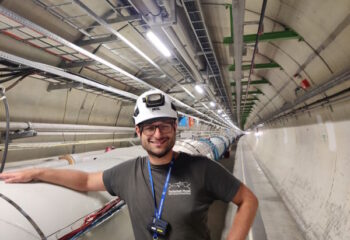
One of my most memorable CERN moments was helping a friend during an intervention on the ATLAS Forward Proton (AFP) detector in the LHC tunnel. I had completed the required safety courses beforehand, including training on the use of the self-rescue mask, which was already an exciting experience.
One Monday morning, my friend called and asked, “Do you want to go to the LHC tunnel today?”. Naturally, I said yes immediately. I quickly requested tunnel access, even calling my supervisor, who was on holiday, to approve it in time.
As a particle physicist, I feel extremely fortunate. Very few people get the chance to enter the tunnel of the world’s largest particle accelerator, let alone work on a detector there. Even among CERN staff, this is far from guaranteed.
What advice would you give potential applicants?
Don’t overthink it. Write a motivation letter and apply. Many people assume that only the absolute elite have a chance of working at CERN, but that is not true. If you are qualified for a position, genuinely interested, and able to show your motivation, it is always worth trying. With a bit of luck, you might find yourself here.