


Tell us a little about yourself… What do you do at CERN today?
I’m a data scientist at CERN’s MechLab, where I work on the FCC-ee Digital Twin to understand and predict the tiniest vibrational shifts in one of the most repeated assemblies of the 91-km Future Circular Collider. For my master’s thesis at CERN, I built the data architecture that allows us to foresee alignment changes during component prototyping. Today, I combine high-precision sensor data with detailed virtual models to help engineers design the next generation of particle accelerators. I work at the intersection of engineering, simulation, and data science, integrating real-time measurements with high-fidelity virtual models to generate operational insight.
What is working at CERN like for you?
Working at CERN feels like a dream. For the FCC project, every day I get the opportunity to collaborate with and learn from some of the best simulation experts and mechanical engineers. I am contributing to something that is bigger than myself and will outlast me. I remain deeply grateful to my supervisor for trusting and guiding me along the way.
What inspired you to pursue a career in STEM?
I would say my parents. My mother used to work as a teacher, and my father is a mechanical engineer. I drew inspiration from their curiosity and dedication. While my academic scores were not great, my curiosity, love for problem-solving, and creative thinking kept me exploring. With perseverance and a bit of luck, those efforts eventually led me to pursue a career in STEM.
What skills have you developed since joining CERN?
Since joining CERN, I’ve developed expertise in designing complex IoT based data ecosystems which are being used for real-time mechanical digital twins. To lead the digital transformation of EN-MME MechLab, I had to articulate and present abstract ideas. Doing so allowed me to improve my communication and problem-solving skills. Most importantly, I learnt to adapt to challenges while keeping a positive outlook. Through this journey, I’ve realized that progress comes from combining technical skills with the ability to work effectively with people.
What challenges have you encountered along the way?
Digital twins demand precision in a world full of noise, and that has been one of my biggest challenges. One of my initial tasks was to design a data system where the smallest measurement errors could shift an entire analysis. With steady guidance from my mentors and constant support from my colleagues, I learned how to navigate these micro-scale precision challenges, stretching my skills and strengthening the system along the way. My role in digital transformation adds another layer of complexity, as I integrate tools and implement workflows that allow high-frequency measurements to be synchronized, processed, and visualized in real time so stakeholders can monitor activities seamlessly.
I am fortunate to work with a team that values excellence, innovation, and efficiency, because every challenge becomes an opportunity to create impact. I am now working on integrating remote seismic sensor data for predictive strategies and machine interlocks, combining physical modelling with artificial intelligence to detect anomalies before they escalate.
What’s the most “CERN moment” you’ve experienced?
One of my most unforgettable CERN moments was the day I was able to stream vibration data from sensors on the equipment to a real-time dashboard. Another was when my supervisors told me I had been selected as a CERN graduate. After joining as an intern, CERN chose to trust me with more responsibility. Both moments remind me that dedication, focus, and trust are at the heart of everything we do here.
What advice would you give potential applicants?
Apply even if you feel you are not ready. CERN is not looking for people who have all the answers but for those who never stop asking questions. Stay flexible in how you learn and be open to new learnings. If you join, you will discover that the world’s biggest discoveries are made by ordinary people who believe in extraordinary possibilities.
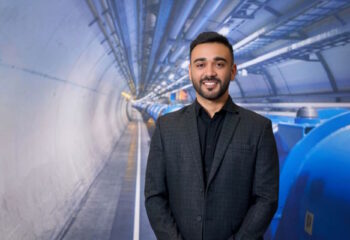
Lakshit
Graduate in Data Science
I am fortunate to work with a team that values excellence, innovation, and efficiency, because every challenge becomes an opportunity to create impact.