


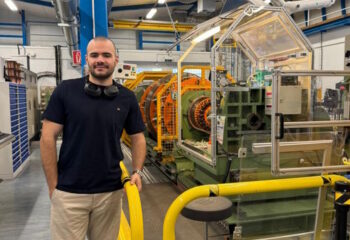
Tell us a little about yourself and what brought you to CERN?
My name is Javier Presmanes Cardama, I am 27 years old, and I hold a master’s degree in Artificial Intelligence from the International University of Valencia (VIU).
Since I was a child, I have always been a curious person with a strong desire to learn new things. More than 10 years ago, while watching YouTube, I discovered a Spanish science communicator named Javier Santaolalla, who had completed his PhD at CERN and was explaining particle physics. At that time, I was still a high school student without much knowledge of the subject, but I was fascinated by his explanation of the Penning Trap in the ALPHA experiment.
That was the moment I first learned about CERN and the work carried out here. From then on, I kept following Javier’s content and other science communicators on YouTube, deepening my interest in particle physics and related topics.
What do you do at CERN today?
I am currently developing an anomaly detection system for the manufacturing process of superconducting cables. To achieve this, I analyse data from different sensors that, combined, make it possible to identify potential defects during production and improve quality control. For this purpose, I use machine learning techniques together with feature analysis.
What is working at CERN like for you?
For me, working at CERN is a unique experience, both professionally and personally. It is not only a highly technical environment where you can learn from the best, but also a place where you meet people with interests very similar to your own.
I feel very proud of the scientific progress made possible thanks to an environment like CERN. These are the kinds of initiatives I believe we must continue to support, as they allow humanity to move forward.
What inspired you to pursue a career in science?
Since I was a child, I have been fascinated by knowledge. For me, being able to explain the world around me has always been essential. This curiosity is what led me to study for a scientific career and, eventually, apply to work at CERN.
What skills have you developed since joining CERN?
I believe the skill I have developed the most is the ability to solve problems efficiently. In research, you spend countless hours studying a problem without any guarantee that anyone has solved it before. Investing that time in understanding and exploring different solutions helps you develop an intuition for what is worth trying and what is not—something crucial for making progress.
What have been the main hurdles or challenges you encountered along the way?
In line with what I mentioned earlier, one of the main challenges is that, due to the very nature of research, you often lack a clear reference framework or guidelines to measure your results. That can be frustrating, but it is part of science, and you learn to live with it.
Any favourite memories from your time at CERN so far? (What’s the most “CERN” moment you’ve experienced?
Without a doubt, the Hardronic Music Festival. Every summer, I really enjoy attending this music event at CERN’s Prévessin site. It’s a fantastic atmosphere to spend time with friends and listen to colleagues who work hard all year and take the stage for that day. It is a very special event and, for me, highly representative of CERN’s spirit.
What advice would you give to potential applicants?
Don’t give up! At first, you may not meet all the requirements for a given position, but that doesn’t mean you don’t stand a chance. Keep trying, ask for feedback after interviews, and make steady progress. If you truly want to work at CERN, don’t stop pursuing it—there is a constant flow of projects, and exciting opportunities are always arising. I’m sure you’ll find one that’s the right fit for you.